
What Is the Euro Stoxx 50 Index and How Does It Work?
Indices allow traders to invest or trade a basket of stocks, grouped by industry, market cap or other categories. They provide built-in diversification, lower volatility and reflect whole-market sentiment.
Traders looking to buy European stocks will find the Euro Stoxx 50, an index that captures some of the largest businesses operating in the Eurozone. It’s one of Europe’s best-known indices, often considered when analysing the economy of the EU as a whole.
Given its importance, the Euro Stoxx 50 index is popular with traders all over the world, attracting heavy daily trading volume. Here you’ll find everything a trader needs to know about it, including a rundown of the biggest Euro Stoxx 50 index companies.
What is the Euro Stoxx 50 and How Is the Index Built?
The Euro Stoxx 50 is an index managed by STOXX Ltd., a longstanding index provider owned by the Deutsche Börse Group. It was one of STOXX’s first indices, launching in 1998. Since then, it has become a popular European stock market index for trading blue-chip companies within the EU.
Like with other indices, the number in Euro Stoxx 50 means it tracks 50 of the Eurozone’s largest companies. ‘Largest’ in this case refers to market capitalisation. Selected companies must also be in the Eurozone.
As mentioned, other indices select for companies based on market sectors, dividend status or asset classes like oil and gold. Before diving into the Euro Stoxx index, traders should know how market indices work.
Euro Stoxx 50 Index Companies and Sector Composition
Since the Euro Stoxx 50 sorts by geography and market cap, it covers a diverse range of industries within the European economy. By selecting for market cap, it includes blue-chip companies that operate on a global scale.
Its organisers review annually, where the 40 top companies are chosen by free-float market capitalisation. They select the final ten from the largest current stocks remaining.
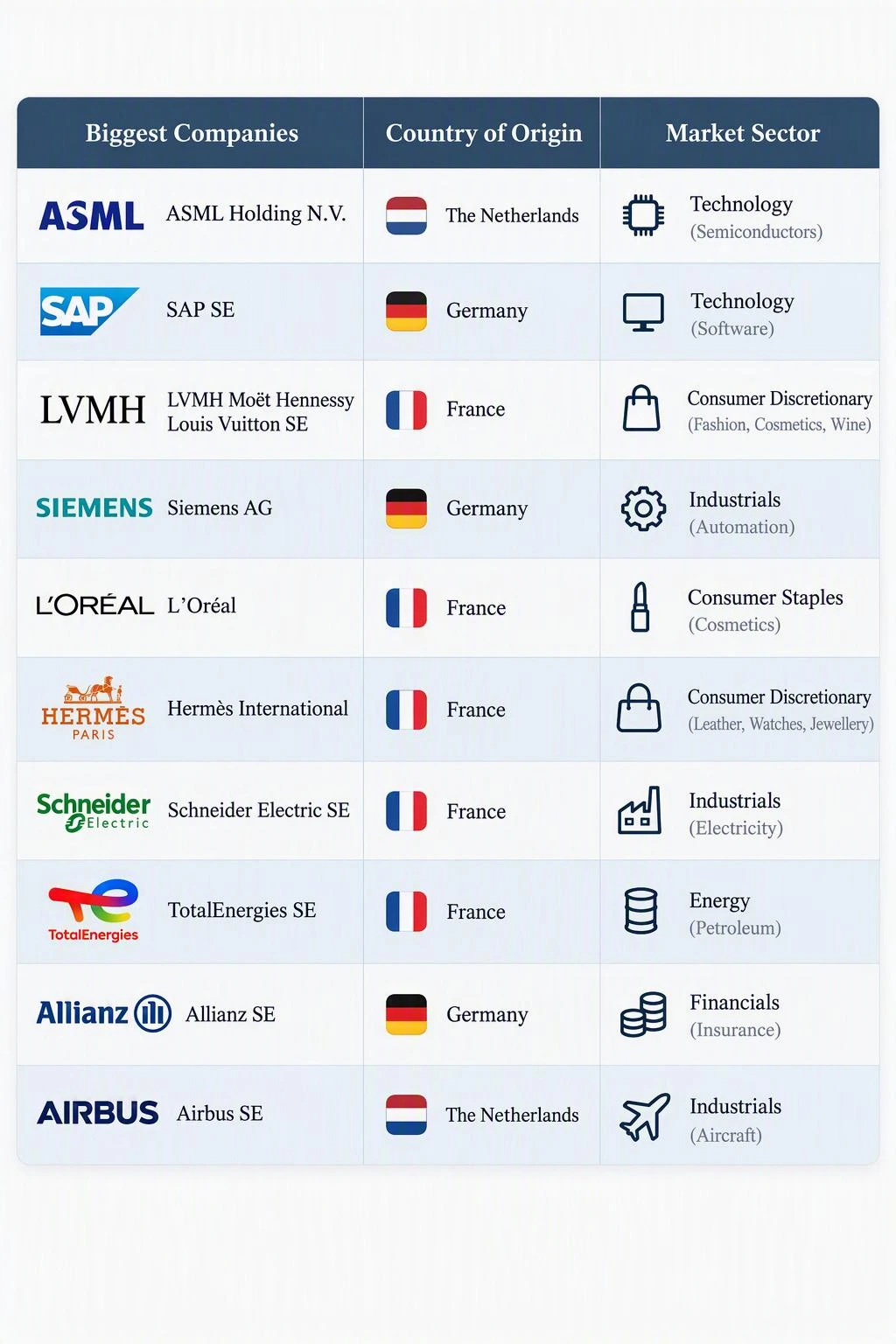
By sector, Euro Stoxx 50 companies lean heavily toward Financials and Industrials, with further representation of Consumer Discretionary (luxury goods). Some of their top companies include technology and energy giants, plus consumer staples through household names like L’Oréal.
For traders, knowing the companies and sectors targeted by the Euro Stoxx is important because it’ll influence how price moves. Any European stock index will give exposure to the continent’s businesses, but sectors show where each company operates. Financial and industrial markets move the Euro Stoxx more than consumer staples, for example.
Knowing the composition of the Euro Stoxx 50 allows traders to analyse out-of-market events that could impact their position. Derivative traders may use Euro Stoxx futures to hedge, another instance where the index composition can be important.
While most of the Euro Stoxx 50 mainly includes financial and industrial sectors, its ten largest companies are quite diverse. Take a look at the table below:
What Moves the Euro Stoxx 50 Index?
Sectors help explain how the Euro Stoxx 50 exposes traders to market movement, but what actually moves it? With a big blue-chip index like the Euro Stoxx, that could be a lot of things.
First, macroeconomic performance like GDP growth, PMI data and employment figures for all member states will shape the market. This will influence how any European stock market index moves, including the Euro Stoxx 50 share price.
Expect sectors like Financials and Consumer Discretionary to do well during high economic growth. During downturns, expect Consumer Staples and Utilities to be more resilient. Industrials, Financials and Consumer Discretionary sectors are also the most sensitive to the economic cycle.
For the Euro Stoxx, interest rates can cut both ways. Generally, higher rates raise company costs and have a negative impact on business. However, it means banking sectors bring in more money. As discussed, the Euro Stoxx 50 covers a lot of financial services.
Inflation, and specifically central bank actions in response to inflation, will also move markets. Naturally, it’s the European Central Bank that moves the Euro Stoxx share price the most. Policy decisions and the tone of forward guidance will influence how bullish or bearish the market will be. Traders should understand how central banks shape markets.
Remember that Germany and France are most represented, so the economic situation there will have a greater influence. That brings us to geopolitical events like members’ energy security, trade policy, euro currency strength and more.
Lastly, the actual performance of each company in the index, and investor responses to that performance, also have their say. All else being equal, the hypothetical collapse of giants like ASML or LVMH could bring the Euro Stoxx share price down.
How Traders Access the Euro Stoxx 50 Market
Traders get exposure to the Euro Stoxx 50 in three ways.
- ETFs
- Index Funds
- Derivative Contracts
Since buying stock in all 50 companies is unrealistic, most traders get exposure to the Euro Stoxx 50 index through ETFs or index mutual funds. As for the derivatives, they’d be CFDs and futures.
Exposure through stock ownership is simple; traders hold a portion of the pooled investment vehicle, which itself owns the underlying securities. Derivatives instead speculate on the Euro Stoxx 50 share price without owning any stock. They are also open for leverage.
Contracts For Difference (CFDs) allow traders to potentially profit from the opening and closing price of the contract. Depending on how the Euro Stoxx share price moves in the intervening period, the contact may make or lose money.
Futures are contracts to buy or sell the underlying asset at a set price, at a chosen date. With Euro Stoxx futures, the asset isn’t a physical one like oil or gold. Instead, it derives from the Euro Stoxx share price. The trader owns no stock; the contract comes with expiration dates built in and require margin to maintain.
Euro Stoxx 50 FAQs for Beginners
Does the Euro Stoxx 50 Pay Dividends?
Yes, but only because the underlying companies in the index distribute dividends to shareholders. Traders need to own stock to qualify, which means buying through an ETF, index fund or specialised dividend tracker.
Does the Euro Stoxx 50 Include the UK?
No, the Euro Stoxx 50 is exclusive to the Eurozone. That means companies operating within the European market using Euros. As such, no British business has ever been added into the Euro Stoxx 50. STOXX Ltd. does offer a Stoxx Europe 50 index with a wider scope, which includes British business.
Is the Euro Stoxx 50 an Equivalent of the S&P 500?
No, the Euro Stoxx 50 is too focused and only focuses on Euro business. For a wide-reaching, whole-market index in Europe, the Stoxx Europe 600 is most like the S&P 500. It lists the 600 biggest companies traded across Europe (included non-Euro countries).
The information provided does not constitute investment research. The material has not been prepared in accordance with the legal requirements designed to promote the independence of investment research and as such is to be considered to be a marketing communication.
All information has been prepared by ActivTrades (“AT”). The information does not contain a record of AT’s prices, or an offer of or solicitation for a transaction in any financial instrument. No representation or warranty is given as to the accuracy or completeness of this information.
Any material provided does not have regard to the specific investment objective and financial situation of any person who may receive it. Past performance is not a reliable indicator of future performance. AT provides an execution-only service. Consequently, any person acting on the information provided does so at their own risk.