
SpaceX’s First Earnings Report: Can Musk’s Vision Justify a $1.4 Trillion Valuation?
SpaceX is about to face its first major test as a public company. The rocket and satellite company will report its first earnings results on August 4 after the U.S. market closes, giving investors their first opportunity to assess its financial performance.
From IPO Euphoria to a $500 Billion Market-Cap Loss
SpaceX entered the public market with enormous investor demand. Shares were priced at $135 during the IPO, valuing the company at close to $1.4 trillion, before the stock surged to almost $200 just days after its debut.
The enthusiasm has since faded dramatically. SpaceX shares are now more than 50% below their post-IPO intraday high, while the company has lost more than $500 billion in market capitalization since its first trading session on June 12.
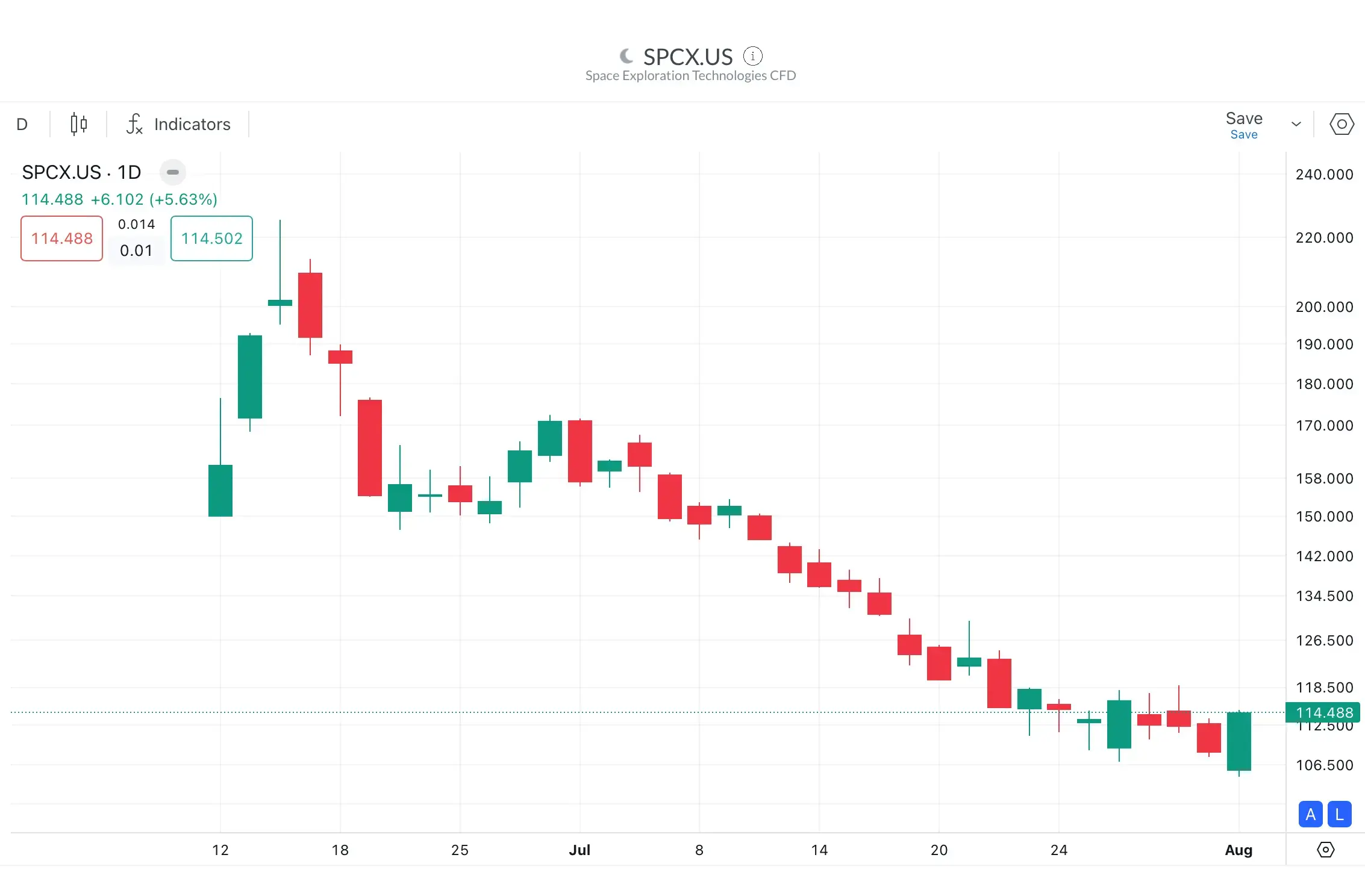
SpaceX Daily Chart - Source: ActivTrader Trading Platform
The decline has coincided with growing caution around some of the stocks most exposed to the AI investment cycle.
While SpaceX is primarily a space and communications company, AI has become an important part of its growth strategy. Investors have become increasingly selective around highly valued artificial intelligence stocks. Why? Because they are questioning whether the heavy capital costs of AI infrastructure will deliver strong returns on investment.
Additionally, lock-up restrictions post-IPO will expire on August 6, potentially allowing early investors to sell shares. This could increase the supply of stock available to the market and add further volatility. Short sellers have already benefited from the decline. According to S3 Partners, short sellers had accumulated roughly $8.3 billion in paper profits since the IPO by late July.
Investors Are Betting on Musk (and the Future)
A large part of SpaceX’s valuation reflects what the company could become rather than what it generates today.
Investors are betting on Musk’s ability to transform SpaceX into much more than a rocket company: a global satellite communications provider, a reusable launch platform, an AI infrastructure business and potentially a provider of computing capacity in space.
That creates what could be called a Musk premium.
The challenge is that SpaceX’s current financial metrics do not easily support a roughly $1.4 trillion valuation. The company’s trailing price-to-sales ratio is in the 70s, while it lost almost $5 billion in 2025 on $18.7 billion in revenue. In the first quarter of 2026, it lost approximately $4.28 billion.
This makes the earnings report particularly important: investors need evidence that the company’s underlying businesses are growing rapidly enough to eventually justify today’s valuation.
Starlink Is The Business That Matters Most Today
Among SpaceX’s various projects, Starlink is arguably the easiest for public-market investors to evaluate.
The satellite communications business provides recurring revenue through subscriptions and is currently SpaceX’s only profitable segment. In the first quarter of 2026, Starlink generated just under $1.2 billion in profit. Traders will pay close attention to subscriber growth, revenue trends and profitability.
Strong subscriber growth would reinforce the argument that Starlink can become an increasingly powerful cash-generating business capable of financing some of SpaceX’s more ambitious projects.
A slowdown could have the opposite effect, raising questions about whether the connectivity business can grow quickly enough to support SpaceX’s expanding capital requirements.
Starship Could Be the Biggest Long-Term Catalyst
If Starlink represents SpaceX’s financial engine, Starship could be its biggest long-term valuation catalyst.
The approximately 400-foot rocket is designed to be fully reusable and significantly more powerful than SpaceX’s Falcon rockets. If successful, Starship could dramatically reduce the cost of launching satellites, cargo and eventually humans into orbit.
That would have major implications for Starlink. Lower launch costs and greater payload capacity could allow SpaceX to deploy larger and more capable satellites more quickly, expanding its communications network.
Starship is also closely linked to SpaceX’s ambitions for orbital computing and other commercial applications in space.
For traders, the question is less whether every test is successful and more whether the company remains on schedule for commercial payload launches. SpaceX has indicated that Starship could begin delivering payloads into orbit during the second half of 2026.
Any significant delay could therefore weigh on the stock because Starship underpins several elements of the company’s long-term growth narrative.
AI Capex Is The New Pressure Point
Perhaps the biggest new question for SpaceX concerns artificial intelligence.
The company’s AI business generated approximately $3.2 billion in revenue in 2025, with first-quarter 2026 sales reaching around $818 million. However, investors are increasingly concerned about the cost of building the infrastructure required to support this expansion.
AI-related capital expenditure more than doubled between 2024 and 2025. That puts SpaceX in a similar position to other technology companies investing heavily in AI: spending enormous amounts today in anticipation of much greater revenues tomorrow.
The difference is that SpaceX’s valuation already assumes substantial future growth. Investors will therefore want to know whether AI revenues are growing quickly enough to justify the additional investment.
SpaceX has already begun monetizing some of its computing infrastructure by leasing capacity to other companies. Google reportedly agreed to a deal worth around $920 million per month for AI compute capacity, while Anthropic and Reflection AI have also signed agreements.
These contracts could provide an important source of revenue while SpaceX develops its own AI models and services.
The planned acquisition of AI coding startup Cursor for approximately $60 billion adds another layer to the strategy. Investors will want more clarity on how the deal fits into SpaceX’s broader AI ambitions and whether the company can compete effectively with established players such as OpenAI and Anthropic.
Bottom Line: What Should Traders Watch?
The long-term bull case remains centred on 3 major growth engines:
- Starlink’s recurring cash generation,
- Starship’s ability to transform launch economics,
- and AI infrastructure’s potential to create a new high-growth business.
But investors are wondering if these ambitions can generate enough revenue, cash flow and profits to justify SpaceX’s enormous valuation. The headline revenue and earnings figures will matter, but several other indicators could be more important for the stock’s reaction.
Here is what you might want to focus on:
- Starlink: Subscriber growth, revenue and profitability will show whether SpaceX’s core commercial business continues to strengthen.
- Starship: Look for evidence that the company remains on track for orbital payload delivery and greater rocket reusability. Delays could put pressure on the valuation.
- AI capex: The critical question will be whether investment is accelerating faster than monetization. Rising spending without a convincing revenue trajectory could reinforce concerns about SpaceX’s valuation.
- Management guidance: Because this is SpaceX’s first earnings report as a public company, you have no established year-over-year public-company earnings history. Management’s outlook will therefore be particularly important in shaping expectations for future quarters.
- Market’s reaction: You might not just analyse whether SpaceX beats or misses financial expectations, you are likely to focus on the overall market participants’ reaction. With the stock already down more than 50% from its post-IPO peak, some disappointment may already be priced in. Conversely, even strong numbers may not be enough if investors remain concerned about valuation, capital expenditure or Starship’s timeline.
“SpaceX’s first earnings report as a public company could highlight the gap between the company’s current financial performance and the ambitious expectations embedded in its valuation,” says an ActivTrades official. “For traders, that disconnect could create significant volatility as the market reassesses the outlook for Starlink, Starship and AI investment. CFDs can provide traders with a flexible way to gain exposure to short-term price movements in SpaceX, in either direction, provided that they use disciplined risk management.”
Sources: Reuters, CNBC, MorningStar, Yahoo Finance
The information provided does not constitute investment research. The material has not been prepared in accordance with the legal requirements designed to promote the independence of investment research and as such is to be considered to be a marketing communication.
All information has been prepared by ActivTrades (“AT”). The information does not contain a record of AT’s prices, or an offer of or solicitation for a transaction in any financial instrument. No representation or warranty is given as to the accuracy or completeness of this information.
Any material provided does not have regard to the specific investment objective and financial situation of any person who may receive it. Past performance is not a reliable indicator of future performance. AT provides an execution-only service. Consequently, any person acting on the information provided does so at their own risk. Forecasts are not guarantees. Rates may change. Political risk is unpredictable. Central bank actions may vary. Platforms’ tools do not guarantee success.