How to practice trading on a demo account: a 4-week plan
Practice on a demo account is most useful when it follows a plan: written rules, a record of every trade and a regular review. The four-week routine below takes you from learning the platform to reviewing your own decisions. If you are new to demo accounts, start with what a demo account is and how it works
Before you start
- Pick one platform. Practice on the platform you expect to use, so the layout and order tickets become familiar.
- Pick one or two markets. A short list lets you learn how those markets usually move and when they are most active.
- Treat the virtual balance as real. Size each trade as if the balance were the amount you would realistically use. Large positions you would never open with your own money teach the wrong habits.
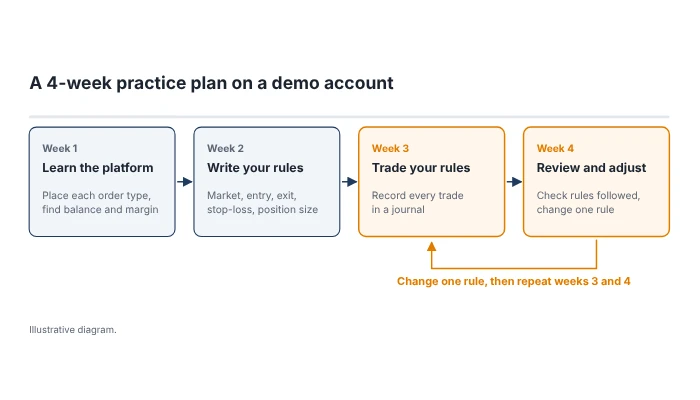
Week 1: learn the platform
The goal this week is to know the platform, not to make trades that work.
- Open and close a position with a market order.
- Place a limit order and a stop order, and watch what happens when each is triggered or cancelled.
- Add a stop-loss and a take-profit to an open position, then move them.
- Find your balance, equity, margin used and free margin, and watch how they change as prices move.
- Set up a chart with the timeframe and the one or two indicators you want to learn.
Week 2: write your rules
Before placing practice trades, write down the rules you will follow. A simple set
covers:
- Market and timeframe: which instruments and which chart timeframe you
will use. - Entry: the exact condition that must be met before you open a trade.
- Exit: where you take profit and where your stop-loss sits.
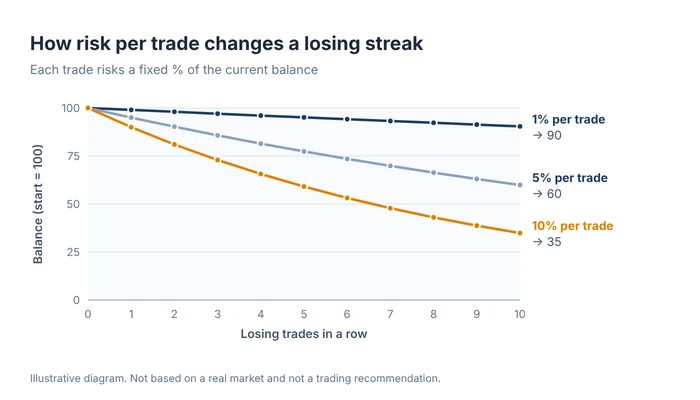
- Position size: how much of the balance you are prepared to risk on one
trade, and how that sets the size.
If you do not have a method yet, our overview of trading strategies explains the
main types (link → S1). Our guide to risk management in trading covers stop-losses
and position size (link → S9).
Week 3: trade your rules and record everything
Place trades only when your rules are met, and record each one straight away:
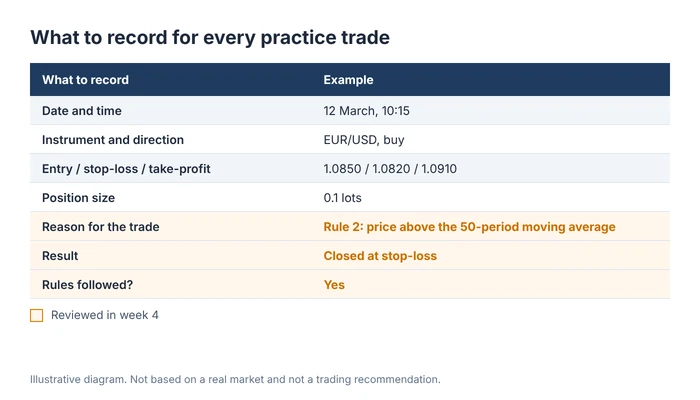
The example values only show the format. A journal shows patterns that memory
misses. More on what to record is in our trading journal guide (link → S10).
Week 4: review and adjust
At the end of the week, read through your journal and answer three questions:
- Did I follow my rules? Count the trades where you broke a rule, and note
why. - What do my losing and winning trades have in common? Look at the
time of day, the market and the reason for entry. What one thing will I change? Change one rule at a time, then repeat
weeks 3 and 4, so you can see the effect of each change.
To test a set of rules more formally, see testing a strategy on a demo account (linkHabits to avoid on a demo account
• Opening oversized positions because the money is virtual.
• Removing or moving a stop-loss to avoid a loss.
• Trading many markets at once before you know one well.
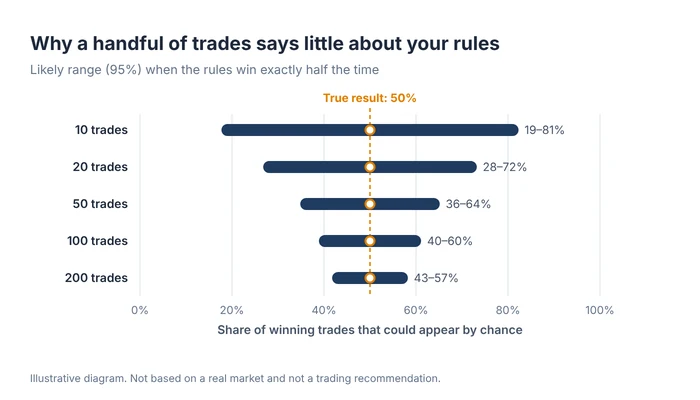
• Judging a set of rules on a handful of trades.What comes after the plan
A demo account shows whether you can follow your own rules. It cannot show how
you will feel with real money at stake. Before you decide anything, read what
changes between a demo and a live account (link → D3) and how long to practise on
a demo account (link → D4).
FAQ (Frequently asked questions )
How many practice trades should I make?
There is no fixed number. A larger sample gives a clearer picture than a few trades, so many traders review their rules after a set number of trades rather than after each one.
Can I practise without a strategy?You can use week 1 to learn the platform without one. After that, written rules make practice measurable: without them,
there is nothing to review.
Should I practise on the same platform I would use live? It helps. Order Tickets, chart tools and shortcuts differ between ActivTrader, TradingView, MT4 and
MT5, so practising on one platform builds habits for that platform.
The information provided does not constitute investment research. The material has not been prepared in accordance with the legal requirements designed to promote the independence of investment research and as such is to be considered to be a marketing communication.
All information has been prepared by ActivTrades (“AT”). The information does not contain a record of AT’s prices, or an offer of or solicitation for a transaction in any financial instrument. No representation or warranty is given as to the accuracy or completeness of this information.
Any material provided does not have regard to the specific investment objective and financial situation of any person who may receive it. Past performance is not a reliable indicator of future performance. AT provides an execution-only service. Consequently, any person acting on the information provided does so at their own risk.